Your team is already using agents. Is it actually working?
Most tech leaders can't answer that question with data. We help you fix that.
You're probably here because one of these is keeping you up
Your engineers are using Claude Code, Cursor, Copilot, maybe all three. Each has their own setup, their own prompts, their own monthly bill on your card.
Productivity feels up. But when leadership or investors ask for proof, you have anecdotes, not numbers.
You know this is the biggest shift in software delivery in 20 years. You also know most teams are doing it wrong. You'd rather not be one of them.
Shadow adoption
Every engineer has their own workflow, tools, and prompts. You have no real picture of what's shipping versus what's stuck in review.
You can't prove ROI
Are you shipping faster than the industry, or just faster than last quarter? Right now you're defending a growing tooling spend with anecdotes instead of numbers.
Compliance is nervous
Legal flags AI for data leakage. Security wants audit trails. You need governance that works with engineering speed, not against it.
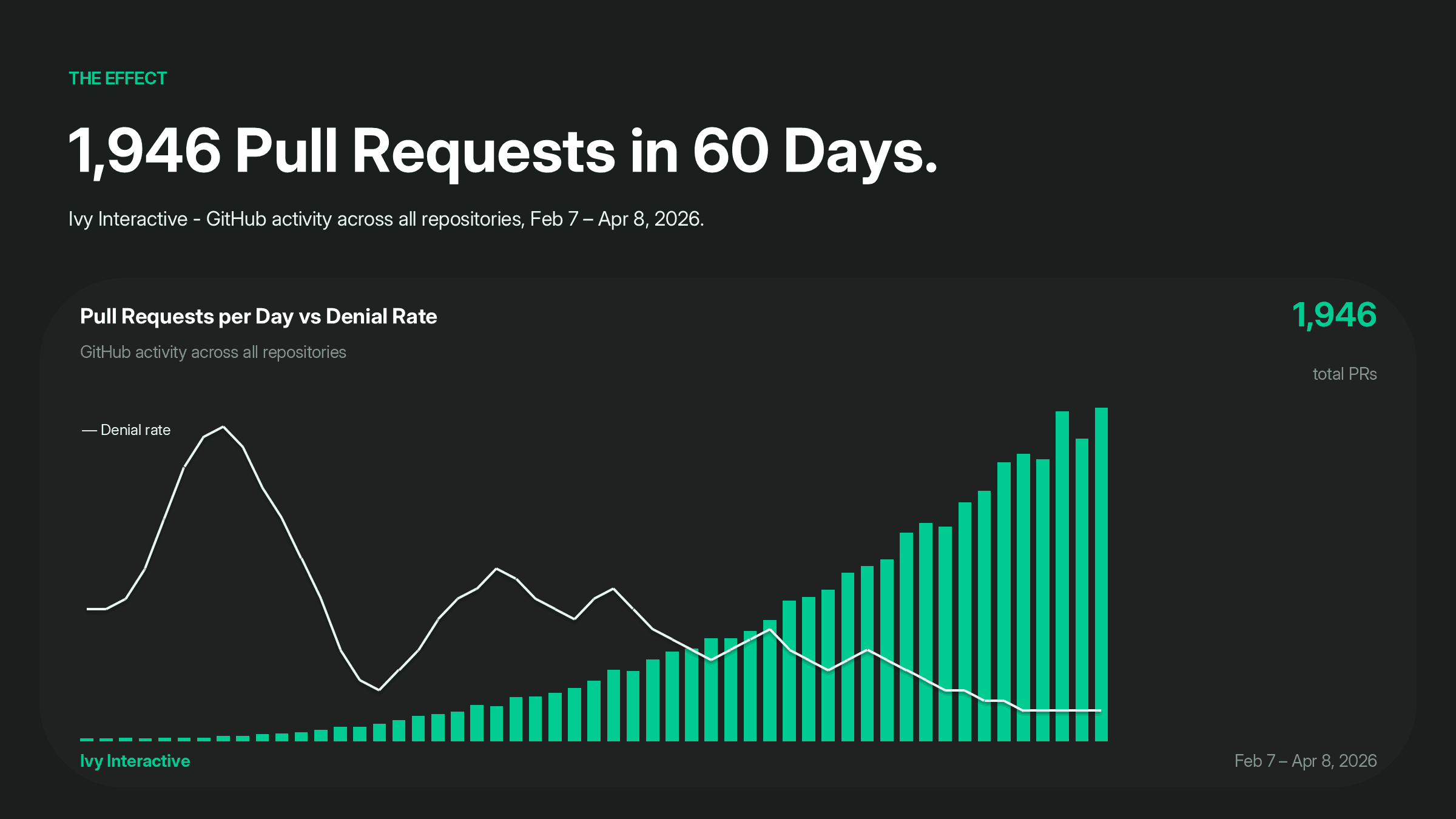
Agent orchestration turns every step into a self-improving, measurable pipeline. By offloading work to agentic jobs developer output becomes something you prove with numbers, not defend with anecdotes.
The numbers that actually prove it's working
You don't need new metrics. You need a few more layered on top of the ones you already trust.
PRs opened, PRs merged, tickets closed, cycle time. Those still work. What changes is the five numbers you add on top.
PRs merged vs industry
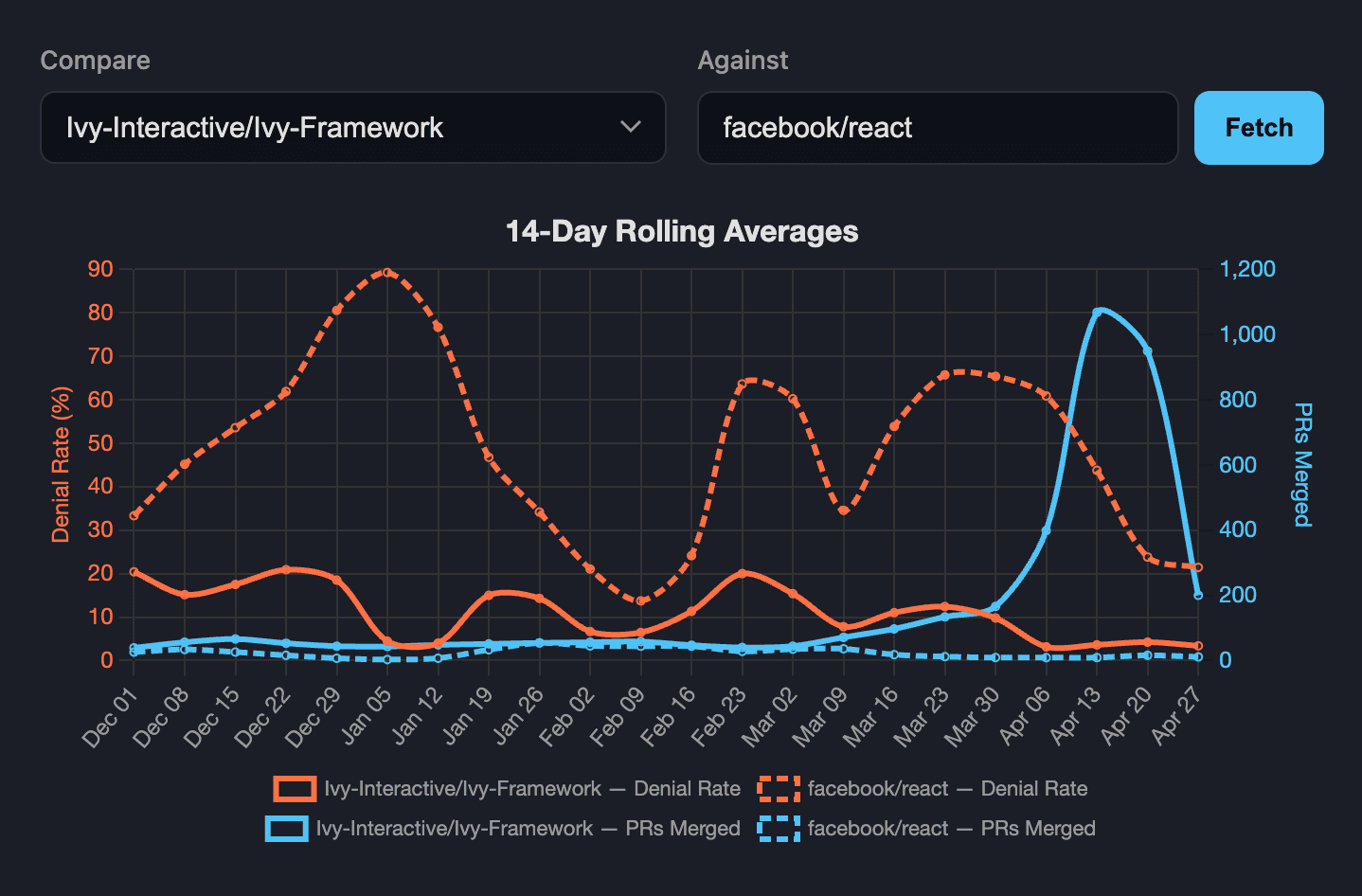
Your throughput against a public reference: react, kubernetes, a competitor's open repo. The honest answer to "are we actually faster?"
Human approval rate
Share of agent-authored PRs a human approves on first pass. Rises as the pipeline learns your conventions.
Agentic approval rate
Share of PRs the pipeline approves autonomously. Starts at zero. Grows as trust compounds on well-scoped work.
Token cost per PR
What each shipped PR actually cost in model spend. Drops as the pipeline learns which model fits each step.
Output per engineer
PRs merged per engineer per week, normalized. The single number you take to the leadership meeting.
Every number above is earned. Ivy Tendril is agentic orchestration software that applies agentic engineering best practices at every step of the software lifecycle, from planning to delivery.
Humans review every PR on day one. As the pipeline proves itself on well-scoped tasks and self-improves, the numbers start moving: approval rates rise, token cost drops, output per engineer climbs. Engineers spend time where it matters: architecture, product decisions, technical direction.
This isn't about replacing developers or chasing AI hype. It's where real software engineering skill meets agentic coding. That's how you scale delivery safely, with numbers to back it up.
See where you stand in 30 seconds
Before you talk to anyone, check the data. Point our open-source PR Cost Calculator at your team's GitHub and any public repo. Compare 14-day rolling throughput, denial rate, and PRs merged. You against react. You against your closest competitor. Public GitHub data, nothing to configure.
Four ways we work with tech leaders
Advise
A 20-minute call, a half-day workshop, or a multi-day audit. An honest read on where your team is, what's working, and what to fix first.
Diagnose
The PR Cost Calculator is open-source and free. Run it yourself. If the numbers surprise you, book a call.
Deploy
Ivy Tendril is our open-source orchestration layer. Self-improving agents, verification gates, isolated git worktrees, human approval on every PR. We deploy it and train your team.
Partner
For teams going deeper, we embed alongside your engineering leadership to build an agentic engineering practice end to end.
We don't replace your engineers. We amplify them, and give you the measurements to prove it.
Explore Tendril on GitHub30 minutes. No pitch.
A concrete read on your setup from someone who's done this at scale: where to start, what to avoid, and how your team becomes one of the fastest builders in their industry.
Book if you run engineering (CTO, VP of Eng, or founder), your team is already piloting AI coding tools, and you're serious about making it reproducible. If that's not you yet, start with the calculator.
No deck. No sales engineer. A founding engineer on the call.