The 8 levels of AI-assisted development, and why most teams plateau at level 3.
I spent the past year writing software with AI coding agents: Claude Code, Codex, Gemini. The first week feels like 10x. By month two, the backlog has grown again and the slow work (review, security audits, refactors) is still slow. The plateau is real, and it is structural.
The pattern shows up in every engineering team I talk to. The agents help individuals, but team throughput has not actually shifted. Features still slip past Q3. The slow work stays slow.
The fastest diagnosis of why is Steve Yegge's.
The 8 levels of AI-assisted development
Steve Yegge published 8 Levels of AI-Assisted Development at Augment Code in 2025. It is the cleanest map of how engineering teams actually use AI today.
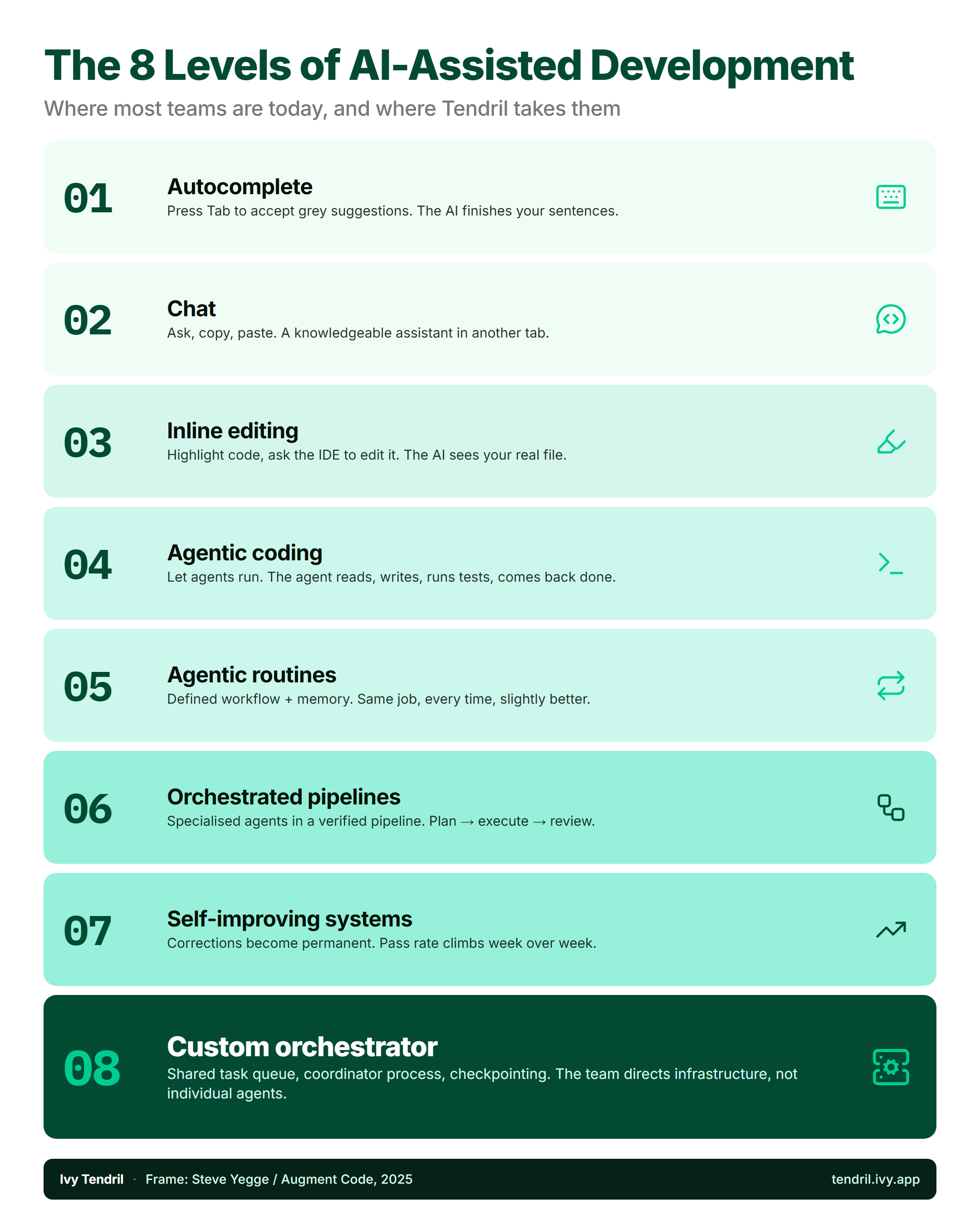
Most teams plateau between level 2 and level 3. That is where Copilot, Cursor, and Claude Code naturally sit. Buying a more advanced agent does not move you up the scale. The shift to level 8 is structural and requires engineering the workflow around the agents.
Where you land determines what compounds
At levels 2–3 you get individual productivity. One developer plus one agent ships a little faster. That is real, and it is the ceiling at that level no matter how many seats you buy.
At level 8 the whole team's throughput compounds. The orchestrator coordinates work across people, repos, and agents, and the system accumulates institutional knowledge about how your codebase wants to be worked on. That is where the 2× output number comes from. It does not appear at level 3.
The level-8 primitives are not off-the-shelf. You need a task queue so two agents never pick up the same work, a coordinator that assigns jobs by priority, and checkpointing that recovers from failures without losing context. Around those, you need agents customised to your domain, persistent memory so the orchestrator learns how your codebase wants to be worked, and measurement engineers actually trust.
Why most consultancies cannot get you there
Making agentic engineering work in production requires three things at the same time: frontier AI capability, agentic-engineering practice (hooks, evals, guardrails, ops), and traditional software discipline (architecture, testing, security, delivery).
Most providers bring one of the three: a lab focuses on models without shipping pipelines; a dev shop ships code without knowing how to run agents around it; a prompt-engineering boutique produces demos that don't survive a year in production. Ivy combines all three because we built our own orchestration platform. That is why production-ready agent workflows take us weeks rather than months.
Tendril is free to start
Ivy Tendril, the platform we use to take teams to level 8, is open source. The source code is on GitHub, the docs live at tendril.ivy.app, and the Discord is open. Any team can install Tendril, build their own orchestration setup, and reach level 8 on their own. We answer questions in Discord and publish back what we learn.
For teams that want a year of self-learning compressed into a few weeks, we offer three engagement packages.
The Boardroom Briefing is a 60–90 minute strategic session for the board or management team. Why now, what changes, where competitors are heading, what to watch out for.
The Move Faster Package is 40 focused hours with an Ivy engineer. Codebase audit, first orchestration setup, first custom agent, team handoff. Dev teams typically start shipping code in two to three weeks.
The Full Implementation is a multi-month engagement for engineering organisations that have decided agentic workflows are core to how they will build software. Custom agents, training, governance, ongoing support.
The packages exist because some teams want experience compressed into time. You can take them or skip them and self-serve.
Read the whitepaper
The full 10-page paper has the engagement scope, EU compliance posture, the FAQ teams typically ask before signing, and a longer breakdown of where Tendril sits on the maturity curve.
Download the Engagement Model whitepaper (PDF) →
Or email renco@ivy.app and we will set up a 30-minute conversation.